Tech Tips
Fabric Case Study - Delivering modern, future-proof reporting with Fabric
Our client wanted to establish a single, centralised, enterprise-level reporting environment that supported reliable insight and consistent decision making.


Our client wanted to establish a single, centralised, enterprise-level reporting environment that supported reliable insight and consistent decision making.
As consultants on the project, we were asked to undertake a review of their business systems and data estate, along with their current reporting provision, and to recommend and build a robust, scalable business intelligence platform to service reports and dashboards in Power BI.
The client’s main aim was to put in place a modern, future-proof analytics environment for real time, role-based reporting while strengthening data governance, and improving the quality and consistency of information used across the organisation.
As well as serving today’s reporting and analytics needs, the new solution needed to be suitable for continued development and advanced data practices such as AI and Machine Learning.
Background & Challenges
The client is an academic establishment delivering professional services to students, apprentices and local businesses across multiple sites. They use many different business and academic applications, resulting in siloed data as well as a variety of reporting solutions, data platforms and toolsets. Their main challenges can be summarised as follows:
- Fragmented data landscape that slows decision‑making
- Escalating costs from disconnected tools and legacy platforms
- Inability to scale analytics and AI across the organisation
- Governance, Compliance, and Security risks when sharing information and insight with a mix of internal and external staff, students and businesses
- Slow delivery of insights due to resource bottlenecks
The client has grown their academic offering significantly in recent times, and it has been difficult scaling existing data solutions to encompass new and growing data sources. Data is currently stored across many locations each requiring separate local governance and security considerations and each hosted on disparate systems.
Due to these disparate systems the availability of reports was slow and unreliable. We could see that this was because platforms were not performing as they should and there was a frequent need for IT intervention. They were using Excel plus a whole array of analytics tools to deliver the reports resulting in delays and concerns over the quality of data. Access to insights was slow and decision making delayed or even impeded by poor or missing data.
Solution Overview
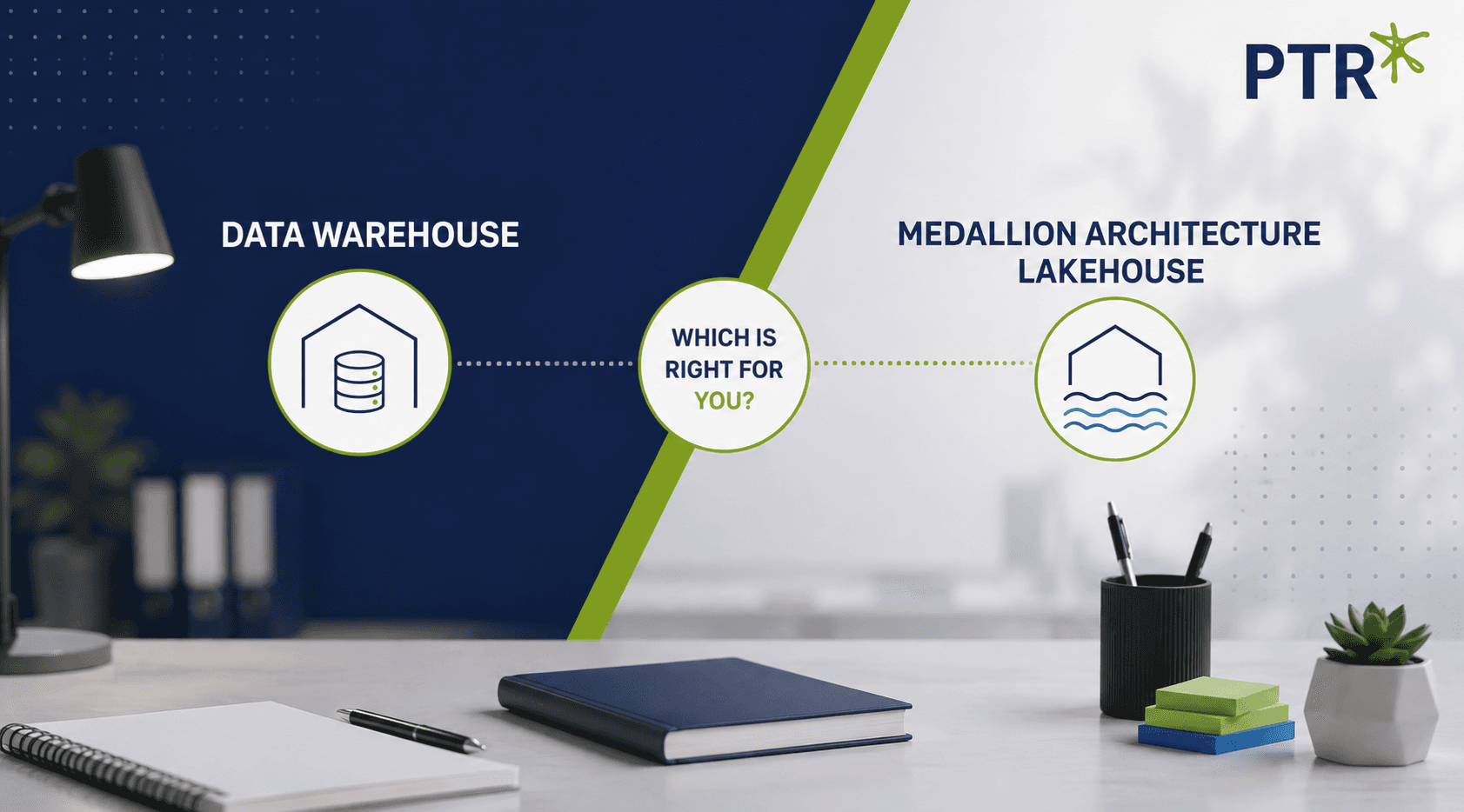
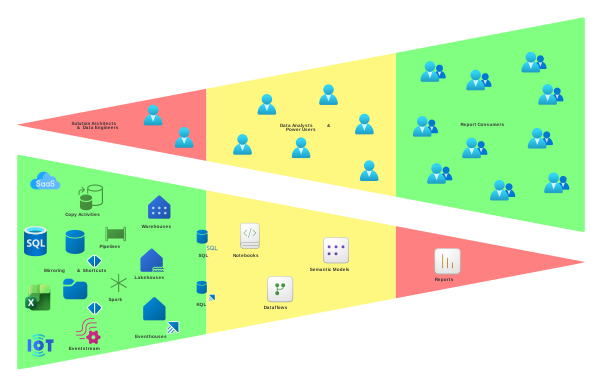
We designed a unified, well-governed, end-to-end modern analytics solution on a futureproof data platform which offered one integrated solution. Built around a Lakehouse architecture this meant structured, semi-structured and unstructured data could all be integrated centrally.
The chosen data platform for this project was Microsoft Fabric which supports a OneLake Lakehouse-first architecture. It is ideal for delivering information in real-time and is ready for advanced data requirements based on AI as those needs arise.
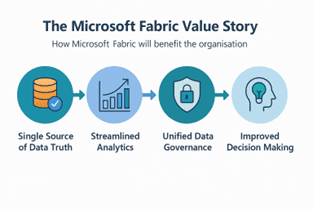
A modern Medallion Architecture approach was taken to create a Single Source of Truth Lakehouse repository and companion semantic model.
Implementation Roadmap
The project began with a discover and design exercise, working with all stakeholders to review the client’s data estate and current reporting provision, and proposing a technical strategy and implementation plan.
Second step was to build the infrastructure and populate a base Lakehouse curated Gold repository. From here a central semantic model was created to serve as a source for all Power BI reporting and dashboards, along with standard Power BI report design templates, and a Power BU suite of core enterprise dashboards.
Future development will include the addition of new data sources, implementation of real-time reporting alongside the batch reporting provided by this project, and the use of AI and Machine Learning against the current lakehouse.
The Technical Solution
Once management agreement was achieved a Microsoft Fabric infrastructure was instantiated with core data components and storage repositories such as workspaces, data lakes, lakehouses and warehouses.
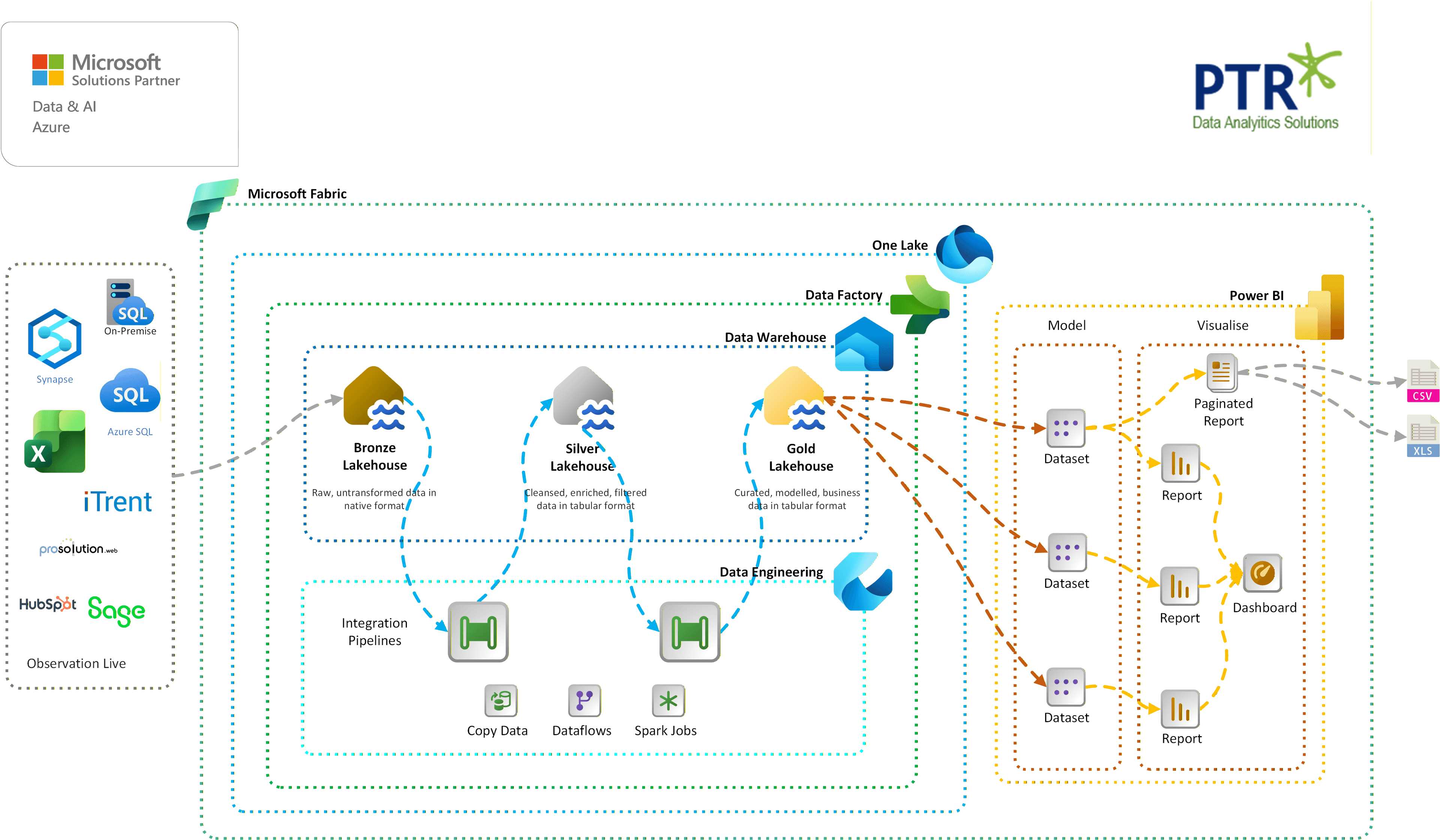
A Medallion architecture was adopted and the necessary Bronze, Silver and Gold repositories were configured and ELT pipelines developed and scheduled to ingest raw data into the Bronze lakehouse layer. Next up data preparation, curation and semantic modelling took place to create the curated Gold Layer of data and an associated Power BI semantic model.
Business Benefits at a Glance
The business benefits of the project were many! From faster insights and better forecasting accuracy to strengthened security and improved governance – here they are at a glance.
- Total Cost of Ownership (TCO) reduced through a unified platform and capacity based licensing
- Lower Operational Overhead with unified Data Engineering & Integration solutions
- Increased financial transparency and forecasting accuracy with a Lakehouse and DirectLake Semantic Model
- Improved regulatory compliance and audit readiness with Purview Governance
- Strengthened security and reduced risk with central security and governance
- Faster insights with Power BI in Fabric
- Future ready analytics with support for AI & ML Workloads
- Reduced reliance on data teams with self-service analytics
- Improved business continuity with Fabric high availability and automatic scaling
- Increase ROI with end-to-end platform integration with a single solution for lake, warehouse, ELT, AI and BI
Conclusion
The new Microsoft Fabric solution has provided the client with:
- Unified, consistent data across the enterprise → faster decisions & reduced integration cost.
- Robust data quality, ready for AI and analytics at scale
- Faster insight delivery, fewer bottlenecks, reduced dependency on fragmented tools
- Enterprise‑grade security and compliance with far less operational overhead
- Better, faster reporting without data duplication → improved decision‑making organisation‑wide
- Readiness for AI adoption with trusted, well‑governed data
- Empowered business units while maintaining central control
- Predictable cost, reduced infrastructure overhead, lower TCO
Microsoft Fabric provides a single, unified data and analytics platform that consolidates lakes, warehouses, ETL tools, and BI systems into one governed environment. This has resulted in dramatically reduced TCO, simpler cost models, lower compliance and security risk, and faster access to trusted data for forecasting and performance reporting. Fabric’s Lakehouse architecture and integrated governance has helped to eliminate technical debt, improve audit readiness, and enable self‑service analytics without losing financial control.
The client now has a cost‑efficient and future‑ready backbone for delivering timely, trustworthy and secure insights to their staff, students and business partners to drive data‑driven decision‑making well into the future.
How Can PTR Help You?
Replicating this case study's success requires a structured, expert-led approach to modernising your data estate.
PTR provides the end-to-end Fabric consultancy and technical implementation, and hands-on training needed to transform siloed systems into a single source of truth using Microsoft Fabric.
MD
Mandy Doward
Managing Director
PTR’s owner and Managing Director is a Microsoft certified Business Intelligence (BI) Consultant, with over 35 years of experience working with data analytics and BI.
Frequently Asked Questions
Couldn’t find the answer you were looking for? Feel free to reach out to us! Our team of experts is here to help.
Contact Us