Tech Tips
Lakehouse - the modern data backbone
Many organisations are rethinking how they manage and use data. The challenge isn’t collecting it so much as making it accessible, consistent, and ready for analytics and AI, without adding more complexity or cost. That’s where the Lakehouse comes in.


Many organisations are rethinking how they manage and use data. The challenge isn’t collecting it so much as making it accessible, consistent, and ready for analytics and AI, without adding more complexity or cost. That’s where the Lakehouse comes in.
If you are not familiar with the terminology, suffice to say that for years, teams built separate systems for data storage and analytics - a lake for flexibility and a warehouse for structure. But this old divide slows innovation and drives up costs. A Lakehouse model changes that, unifying both worlds into a modern data backbone that supports everything from dashboards to AI models.
Here are 10 reasons you should consider a Lakehouse as your modern data backbone:
Reason1: Unified Architecture for All Data Types
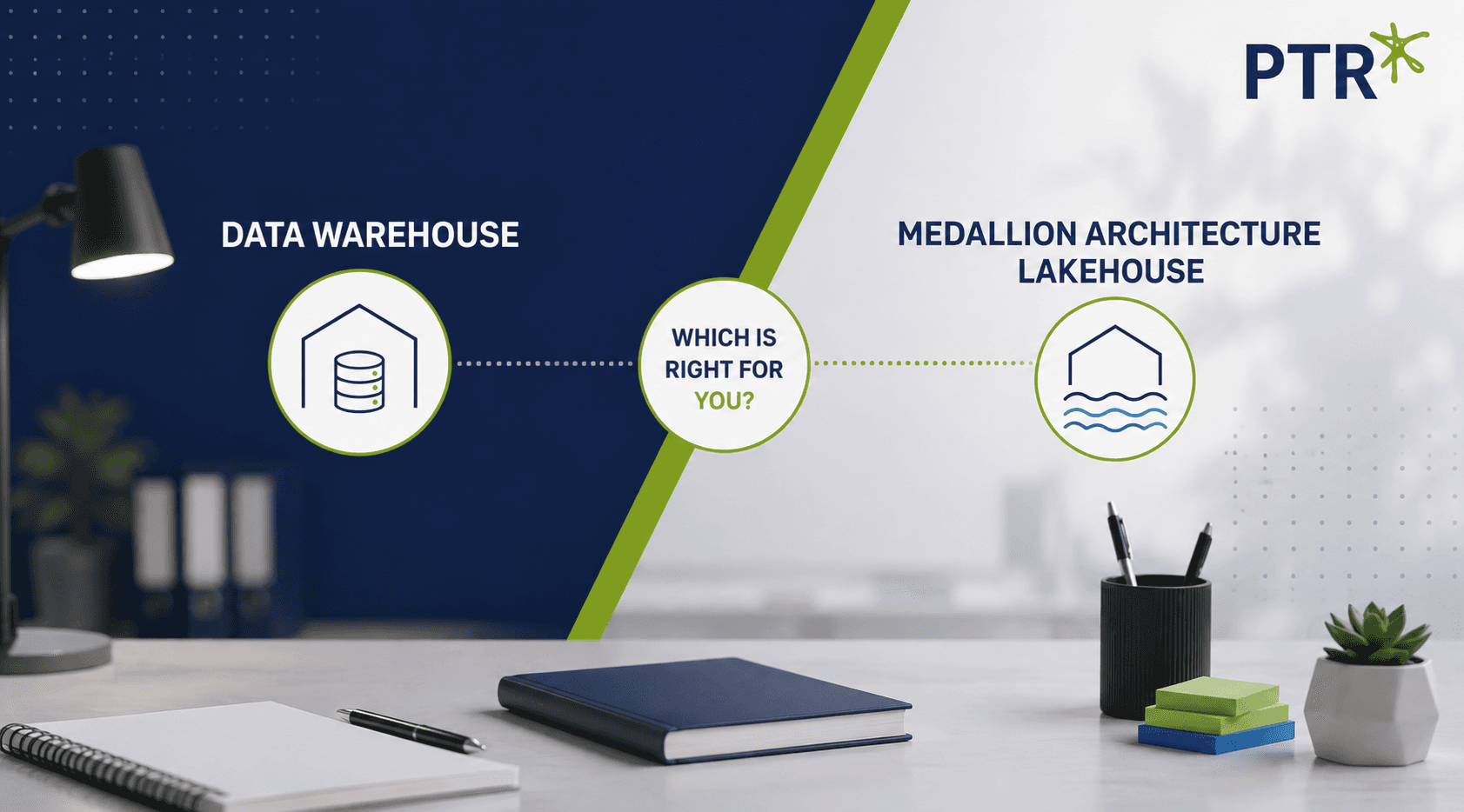
Traditional data solutions centre around a data warehouse to handle the storage and serving of structured data. Semi‑structured, and unstructured data, were later incorporated into the data world via a lakehouse.
Modern data platforms such as Microsoft Fabric provide for a single architecture and solution to house all your data in one place whether structured or otherwise.
Reason 2: Built on Open, Future‑Proof Standards
Lakehouses use open formats (e.g., Delta Lake).
Open formats and standards ensure portability across multiple platforms leading to a longer term more vendor-independent approach to data platform solutions, as well as a more seamless integration with multiple data tools.
Reason 3: Single Source of Truth Across the Organisation
With all your data in one place you have centralised storage and governance, leading to more reliable data for analytics, AI, BI, and operational workloads.
Reason 4: End-to-End Governance and Security
Modern lakehouses (like in Microsoft Fabric) embed governance features such as lineage, policies, classifications, auditing, and data protection without requiring multiple tools.
Reason 5: Dramatically Simplified Data Pipelines
As data is stored in one place movement of data between disparate platforms and locations is dramatically reduced thus simplifying ETL/ELT pipelines. Not only are pipelines simpler but they are often cheaper. The simplified pipelines also lead to more robust data solutions with reduced operational risk and a lower development/engineering cost.
Reason 6: Real-Time + Batch Workloads in One Platform
In the past it would be fairly typical to refresh data for BI and AI purposes overnight or a limited number of times per day due to the performance impact on source systems and the sheer amount of time it took to move data from location to location.
With reduced data movement and fast lakehouse data platform storage, streaming ingestion, event processing, and historical analytics can coexist. This enables real-time dashboards, predictive applications, and up-to-date operational insights to be achieved as well as the more traditional batch workload datasets for the less business critical reporting and analytics.
Reason 7: Designed for Scalability and Performance
Lakehouse data platforms separate storage from processing which makes it much easier to scale compute when needed, independently from storage, and the scaling of storage independently of compute.
The result of this is generally a more cost-effective solution with far more flexibility than traditional data warehouse solutions.
Reason 8: Lower Total Cost of Ownership
Unifying data engineering, storage, compute, governance, and BI can reduce licensing, infrastructure, maintenance, and integration costs when planned and implemented effectively. It should be pointed out, though, that lack of planning could potentially lead to higher costs.
Reason 9: Accelerates AI and Advanced Analytics
With well-governed, accessible, high‑quality data being presented by a unified lakehouse data solution you will have the perfect source for Large Language Models (LLMs), machine learning, and AI initiatives.
Reason 10: Empowers Both Pro Developers and Business Users
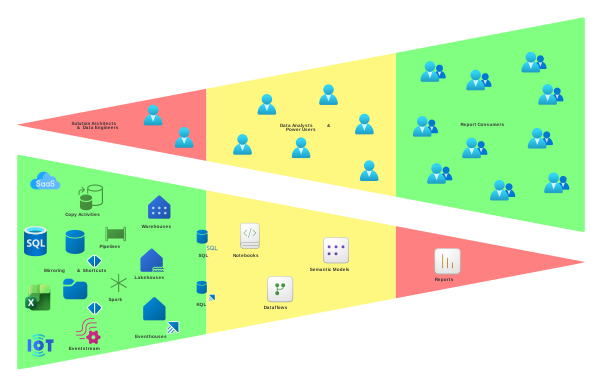
Self-service tools can be built on top of your unified, central, single source of truth, governed data foundation and this means that both technical teams, business analysts and business users can work from the same trusted data. This in turn improves data driven decision quality and reducing bottlenecks where once business might have had to wait for IT resource to deliver dashboards and reports.
Summary
A modern lakehouse provides a unified, open, and governed foundation that brings all organisational data - structured or unstructured - into a single, scalable platform designed for analytics, AI, and real‑time insight. By eliminating the complexity of separate data lakes, warehouses, and integration layers, it reduces technical debt, lowers total cost of ownership, and accelerates delivery of high‑value data products. With built‑in security, governance, and self‑service capabilities, a lakehouse empowers business teams and technical staff to work from the same trusted data, enabling faster decisions, improved compliance, and a future‑proof backbone for innovation. For organisations seeking agility, resilience, and measurable ROI from their data investments, the lakehouse represents a strategic shift toward simplicity, speed, and enterprise‑wide intelligence.
So if you’re planning your next data project, ask yourself - why build a lake and a warehouse separately when one platform can do it all.
MD
Mandy Doward
Managing Director
PTR’s owner and Managing Director is a Microsoft certified Business Intelligence (BI) Consultant, with over 35 years of experience working with data analytics and BI.
Frequently Asked Questions
Couldn’t find the answer you were looking for? Feel free to reach out to us! Our team of experts is here to help.
Contact Us