Tech Tips
Human In The Loop (HITL) - Blending Human & AI
The most sustainable AI strategy is not to remove people from the process, but to strengthen them with the right tools, training and governance.

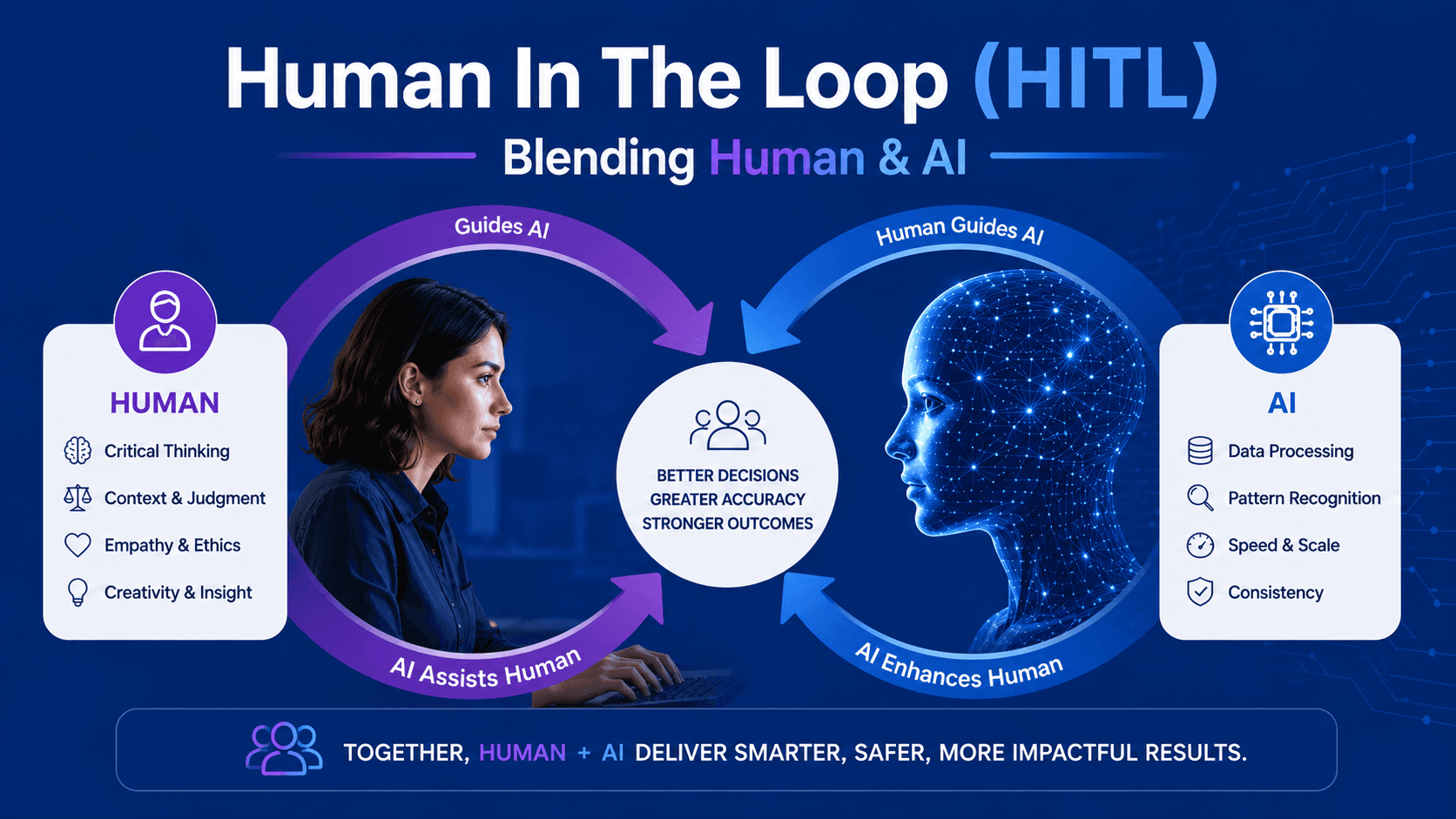
What a journey the world is on with AI. Most businesses have probably been in the experimental phase of working with AI, but some took the leap of faith and rolled out AI driven business solutions. So where is AI being implemented in the main today? Here are some of the top application areas for AI
- Customer Service & Support
- Cybersecurity & Fraud Management
- Customer Relationship
- Workplace Automation & Digital Assistants
- Personalised Marketing & Content Creation
- Inventory & Supply Chain Optimisation
- Recruitment and HR
The biggest AI growth area is with Generative AI, which has made AI accessible to non-technical, non-data science staff, and which is being implemented for tasks such as:
- Rapid code generation and software development
- Product design and build
- Content generation for marketing and communication
- Analysing data
- Automating business processes
In some of these application and task areas AI may be used to easily eliminate manual involvement in clearly defined repetitive tasks, but in others there is a much deeper business logic, security, governance and compliance implication which goes beyond repetitively following simple instructions. So, let's take two statements:
- AI can replace humans and lower your head count
- AI can improve human productivity in the right hands
AI can replace humans and lower your head count
Repetitive Tasks
It is true that some tasks could be moved from humans to AI very easily and successfully - the humans are no longer needed. Task such as:
- Basic customer support - answering standard questions about order status, password resets, returns policy
- Data entry - reading invoices and scanning into financial systems
Neither of these tasks is bound in complex business logic. AI simply follows simple instructions matching pre-defined answers to pre-defined questions and there is no "thinking" to be done. But equally there are many tasks that could lead to devastating consequences if they replace humans altogether:
- Cyber security and Fraud - AI follows patterns, but hackers look for blind spots and create new threats that AI does not know about. Breaches would go unnoticed until too late.
- Supply Chain & Inventory - AI works on the past, what it has already been told to look at, and not the future which could impact decisions. Under or over ordering could damage a business.
- Marketing - AI maybe programmed to optimise content for maximum web site clicks, but this may not always be best for the brand. Reputations could be tarnished and revenues drop.
- Analysing Data, Decision intelligence & Data Engineering - AI delivers answers, but they may be vastly inaccurate. No human sanity checking could lead to poor business decisions.
When you replace a human with AI you will only get the "do It". You will lose the "why?" and "should we?". It is dangerous to replace "judgement" with a repetitive AI task.
Complex Applications
Whilst those who implemented AI in a purely repetitive task application space will likely have succeeded in improving efficiency and reducing head count, those who tried it in the complex application space have found that the path was not a smooth one. What started out as a project that looked easily achievable by non-technical employees using AI tools, turned out to be more costly than going with data engineers in the first place. Why?
- Non-technical staff are often driving complex application development (using AI tools), without understanding the foundations (architecture, infrastructure and services) they are building on top of - or the security, governance and compliance policies in place.
- Complex business logic is not fully understood, and AI tools are prompted with incomplete or quite simply wrong logic
- With no highly skilled data engineer available to prompt, advise, guide and sanity check who can tell you if what you are seeing in outputs is correct?
- Data scenarios and business logic that were not fully understood by unskilled staff got missed altogether by AI tools.
- Digging yourself into a hole. Unskilled "Accidental Data Engineers" who did not understand the solution architecture or generated code that AI built for them in the first place, create new AI prompts to help them solve the problems they created!
- An AI generated app may function, but what happens when it is released into your live estate?
- A poorly designed application could over stress your live environments, cause resource bottlenecks and take your live operational systems out of action
- Can you be certain that your business security, governance and compliance policies have been enforced by this new application? Are you at risk of unwanted data breaches?
- Have you got a good grasp of the costs that will be incurred by running this new AI generated application? Could you end up spending more is service subscription costs that you have saved by not engaging a data engineer?
Many companies that decided to go ahead and build complex applications using AI tools initially found themselves in an exciting phase of rapid development. However, by relying on unskilled staff they ended up in a situation where outputs turned out to be unreliable, driving bad decisions leading to financial and reputational damage.
Along the way they may even have had to find extra funds for bad work to be repaired, asking expert data engineers to come in after the fact and untangle poorly understood AI generated code that was delivering false information.
AI can improve human productivity in the right hands
The last couple of years have been a learning curve for businesses embracing AI and there are some key messages to come out of the period of experimentation. What started out with a narrative of "wholesale job replacement" has moved to a new thinking that the highest return on investment comes from AI-augmented humans, not fully autonomous agents. Can we really afford to replace humans with AI applications? I guess that is for you to decide. But it seems that many businesses are realising that upskilling and training their staff to work with AI tools is perhaps a wiser investment than simply replacing staff.
Don't Replace the Humans!
Now that we are over the initial hump of excitement, anticipation and experimentation around bringing AI into business, we are starting to see some concerns emerging like those outlined above. Sometimes jobs were cut altogether as a result of AI but the cycle is still the same - flaws are discovered in the AI solutions which have replaced human workers, business feels the financial and reputational impact of these errors and humans are brought in once more to unravel the problems.
Gartner published an interesting article on May 7th 2026. 80% of Companies Cut Jobs for AI. It Didn't Improve Their Returns. Not Even a Little.
Their key finding after speaking with 350 global business executives is that "cutting people doesn't correlate with better financial performance".
There is a growing consensus that businesses should be looking in terms of AI boosting staff productivity rather than replacing staff.
The Gartner article highlights the risk to your brand if you simply reduce headcount on the back of early AI adoption and not on sound AI and business strategy.
There may be a short-term gain in reducing the headcount from a P&L perspective, but replacing humans with AI automation could seriously damage your brand and reputation as the human element is removed from the staff and client relationship.
Whilst certain areas of AI automation will replace the need for manual repetitive tasks and legitimately render some aspects of job roles redundant, businesses should perhaps focus on how they can redeploy the staff that have been relieved of those repetitive tasks. Hopefully improved efficiency and faster actions will lead to increased demand further along the business chain.
With the new surge towards AI initiatives and business process automation the risk of detaching the human element may drive both employees and customers away.
If we retrain our staff to work with AI then we can truly gain work efficiencies by utilising AI as a complementary service.
Moving From Substitution to Amplification
Economists use the phrase Substitution vs. Amplification to describe how technology interacts with human labour. There are a few statements that I have come across that I quite like:
- AI allows a single employee to brainstorm, draft, and prototype ideas at 10x speed. However, deploying those ideas into actual production still requires rigorous human sign-off.
- AI is a powerful sandbox tool for exploration, but humans remain the gatekeepers for quality control and operational readiness
- Large language models know a massive amount about general concepts, but they know nothing about your specific company culture, historical customer relationships, or undocumented internal workflows
- AI cannot replace the institutional knowledge held by experienced team members; it can only serve as an assistant to help them surface that knowledge faster
- Organisations that completely automated cognitive tasks over the past year noticed a rapid decline in their teams' critical thinking and problem-solving skills.
- Keeping humans actively engaged in the process prevents skill degradation, ensuring the workforce remains capable of troubleshooting systems when the AI fails.
When a business falsely treats AI as a substitution for an experienced data engineer, the strategy fails. When they treat it as an amplification tool for a skilled human, the business scales safely.
This LinkedIn article provides some interesting insight: UC Berkeley researchers published in Harvard Business Review.
Human Resource and workforce development frameworks use the phrase "Moving From Automation Anxiety to Human Capability Amplification" to reframe how enterprises train staff to use AI as a force multiplier instead of a replacement tool.
Defining Your AI Strategy
For complex applications you are more likely to achieve success if you adopt an AI Enablement Strategy. Look at how you can embrace AI, encourage you teams to use AI, but do it in such a way that you move them from a dangerous over-reliance to a safe AI collaboration.
Elevate your staff to work effectively with AI – maintain your core expertise.
- Train your staff in the importance of quality prompt engineering
- Train your staff in using your chosen AI toolsets
- Ensure your staff understand and validate any content or code that is generated by AI
- Provide them with the necessary foundation skills to understand the outputs
- Business logic
- Business processes, data governance, security and compliance polices
- SQL language
- Python language
- Microsoft Fabric
Maybe one overarching message is to carry out a risk assessment to determine the likely risk level to any business application you are considering for AI projects. Here is a sample matrix for some typical business areas targeted for AI projects:
Business Application | AI Role | Automation Risk Level | Why Humans Are Vital |
First-Line Customer Support | FAQ routing, processing simple returns. | 🟢 Low Risk | Handling complex escalations and showing empathy to angry customers. |
Document Data Entry | Transcribing data from invoices to ERPs. | 🟢 Low Risk | Spotting systemic invoicing errors or vendor fraud. |
Personalised Marketing | Copy variants, basic asset generation. | 🟡 Medium Risk | Protecting brand equity and preventing insensitive messaging. |
Supply Chain & Logistics | Predictive inventory reordering. | 🔴 High Risk | Accounting for real-world "Black Swan" geopolitical and shipping disruptions. |
Cybersecurity | Pattern-based threat monitoring. | 🔴 High Risk | Anticipating creative, novel attack vectors designed to fool AI shields. |
Decision Intelligence & Data Engineering | Code generation, strategic pipeline builds. | 💀 Critical Risk | Conducting logical sanity checks, ensuring data governance, and verifying business reality. |
You can see here that Decision Intelligence & Data Engineering business applications carry the highest risk. False or non-compliant outputs can cost your business dearly.
Start working on your AI Strategy action plan today.
A few tactical steps you can implement immediately:
- Mandate that whoever runs a prompt is personally legally and operationally responsible for the accuracy of the result. This instantly stops blind copying and pasting.
- Block business users from pushing AI-generated SQL or Python scripts directly into live company databases. All AI code must pass through a sandboxed review environment first
- Regularly ask team members to explain the step-by-step logic of a report they built using AI. If they cannot explain how the data was calculated, the report cannot be used for decisions.
- Identify high-stakes tasks, such as final data validation, strategic budgeting, and core architecture design, that must be performed natively by experienced human brains
And here are a few guardrails for safe AI usage to get you started:
- Data Privacy & Compliance
- NEVER paste sensitive company data, customer lists, PII, or internal database schemas into public AI models (e.g., ChatGPT, Claude).
- Only use corporate-approved, enterprise-grade AI instances with active data-privacy wrappers.
- Code & Analytics Deployment
- All AI-generated code must be treated as unverified third-party software.
- No AI-generated script may be deployed to production without a formal peer review by a designated domain expert.
- The "Human-in-the-Loop" Mandate
- AI may be used for initial brainstorming, drafting, and syntax lookup.
- Final outputs used in executive presentations must contain a "Validated By [Human Name]" sign-off.
At PTR we have a team of experts who can help you get started on your AI journey or can help you regroup on a journey you have already begun. We can help you unpick what you have got and figure out how you can get things on track.
Train Staff to Use AI
Equipping your staff with the skills to really fly with bringing AI into their day-to-day roles requires a well thought out learning pathway.
If you do not plan your organisation’s education for your AI data journey you run the risk of staff using AI prompt engineering as a shortcut rather than an acceleration tool. The danger in this is:
- The human stops thinking through a problem and immediately asks an AI to solve it.
- Over time, the human forgets the underlying logic, syntax, or business rules required to do the task manually
- When the AI eventually hallucinates or breaks down, the human lacks the foundational knowledge to diagnose or fix the error
- The business becomes entirely dependent on a black-box system that no single employee truly understands
By ensuring that you AI Strategy includes the Human In The Loop (HITL) policy you will ensure that AI always remains an assistant.
- Design checkpoints where the AI stops. For example, a script cannot be pushed to your live database until a human sign off on a line-by-line logic audit.
- To validate an AI's output, the human must critically think about what the correct answer should look like. This constant evaluation keeps their core domain skills highly active.
- Staff learn to use AI to stress-test their own ideas or write basic syntax, but the human remains the sole author of the strategic logic
The PTR training team can work with you to assess your organisation’s training needs and build an AI learning pathway with you. Here is a sample pathway, and you will find more about our AI Learning path here.
Phase 1: Mindset and AI Literacy
- Shift employee perception from "AI will do my job" to "AI is my tireless assistant.
- Break the "Illusion of Expertise" by instilling healthy scepticism toward unverified AI outputs
- Understanding core concepts – prompt engineering, token limitations, AI hallucinations
Phase 2: Advanced Amplification
- Move beyond basic search prompts to structured, multi-step engineering frameworks
- Chain-of-Thought prompting, role-assignment, setting rigid behavioural constraints, contextual training
- Transition from passive question-asking to active system-direction
Phase 3: Domain-Specific Guardrails
- Apply AI safely to specific departmental workflows while respecting governance rules.
- Data privacy compliance (GDPR/PII masking), secure code isolation, and business logic validation
- Safe, compliant daily usage tailored to data engineering, marketing, or operations
Phase 4: Continuous Human Feedback Loops
- Institutionalise the "Human-in-the-Loop" workflow to prevent a team decline in critical thinking and problem solving
- Move this practice away from an individual choice and embed it directly into the company’s official standard operating procedures (SOPs), software guardrails, and cultural expectations
Summary
In summary, the most sustainable AI strategy is not to remove people from the process, but to strengthen them with the right tools, training and governance. AI can deliver real value when it accelerates repetitive work, supports experimentation and boosts productivity, but in higher-risk areas it must remain under skilled human oversight.
Businesses that build their approach around human judgement, technical capability and clear guardrails will be far better placed to scale AI safely, protect their brand and turn innovation into lasting commercial advantage.
Do get in touch with us to discuss how we can help you on your AI journey.
MD
Mandy Doward
Managing Director
PTR’s owner and Managing Director is a Microsoft certified Business Intelligence (BI) Consultant, with over 35 years of experience working with data analytics and BI.

Frequently Asked Questions
Couldn’t find the answer you were looking for? Feel free to reach out to us! Our team of experts is here to help.
Contact Us